Two dice: why 7 is the most likely sum
Two fair six-sided dice have 36 equally likely ordered outcomes when they are independent. Six give a sum of 7; only one gives a sum of 2. The sums are not equally likely, even though each face on either die is.
The short answer: count ways to make the sum
Call the dice A and B. Each has faces numbered 1 to 6. We assume each face has the same chance, and the result on one die does not affect the other. We also assume separate rolls are independent.
A sum of 7 can come from (A, B) = (1, 6), (2, 5), (3, 4), (4, 3), (5, 2) or (6, 1). A sum of 2 can only come from (1, 1).
That makes P(sum 7) = 6/36 = 1/6, about 16.7%. P(sum 2) = 1/36, about 2.8%. A 7 is six times as likely as a 2 on any one roll. It is still more likely that the sum will not be 7: the other sums together occupy 30 of the 36 outcomes.
Read the grid: one row for A, one column for B
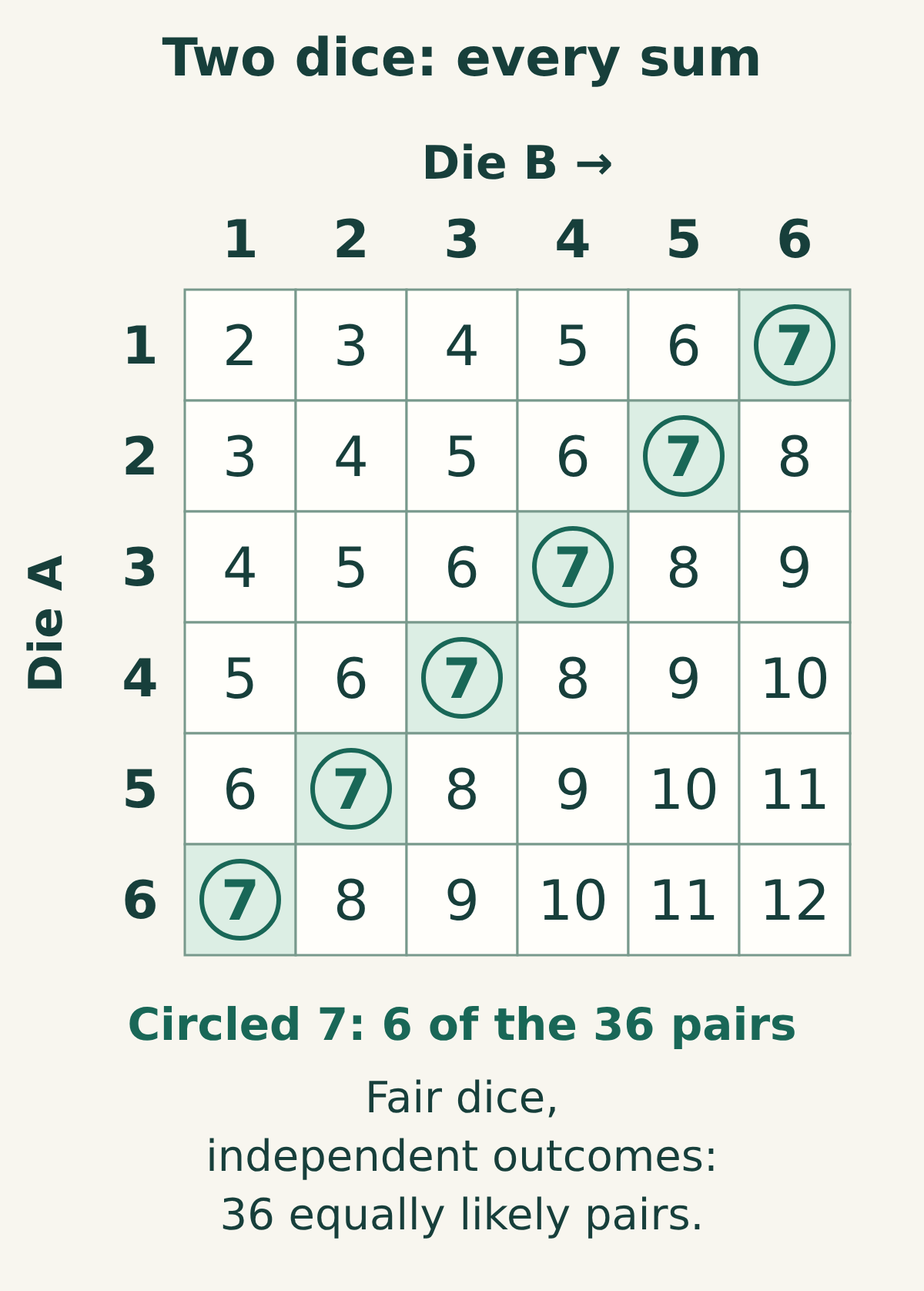
For each of the six possible results on A, there are six possible results on B: 6 × 6 = 36 ordered pairs. Each pair has probability 1/6 × 1/6 = 1/36. A cell shows the sum of its row and column labels.
The six circled cells give 7. Counting the cells for each sum gives the following distribution. The count is a number of possible pairs, not a promise about your next 36 rolls.
- 2: 1 pair out of 36; 3: 2 out of 36; 4: 3 out of 36.
- 5: 4 out of 36; 6: 5 out of 36; 7: 6 out of 36.
- 8: 5 out of 36; 9: 4 out of 36; 10: 3 out of 36.
- 11: 2 out of 36; 12: 1 out of 36.
Why (3, 4) and (4, 3) both count
The totals match, but the dice show different results: A shows 3 in the first case and 4 in the second. Use different-colored dice, or keep their identities as A and B, to see the distinction.
You can group these two outcomes as “a 3 and a 4 in either order”. That group then has probability 2/36. A double such as (3, 3) has only one ordered outcome and probability 1/36.
If you list the 21 pairs without distinguishing order, those 21 groups are not equally likely. Dividing by 21 as if each had the same chance is the mistake. Nor are the 11 possible sums, from 2 to 12, equally likely.
Try it: record 36 rolls
You need two ordinary six-sided dice, a tray, a pencil and the sheet below, or a blank piece of paper. Before starting, predict which sum will appear most often. The theoretical prediction is 7, but a short experiment can have a different winner or a tie.
- Agree on a rule before rolling: if either die lands outside the tray or rests on an edge, reroll both. Otherwise, record the result even if it surprises you.
- Roll both dice 36 times. After each roll, write the sum in the next numbered box. Keep the sequence so you can check the tally.
- Count how often each sum from 2 to 12 appears. The counts must add to 36. If they do not, recount the recorded results.
- Compare each count divided by 36 with its theoretical probability. For example, if your sheet has four 7s, its observed proportion is 4/36, about 11.1%, while the model probability remains 6/36. This is an example, not a reported experiment.
Two-dice experiment sheet (PDF, 1 page)
One page with 36 numbered recording boxes and a probability table. Print on A4 or Letter using Fit.
What a short experiment can tell you
The expected number of 7s in 36 rolls is 36 × 1/6 = 6. “Expected” is a long-run average over repetitions of the experiment; it does not mean every set of 36 contains exactly six 7s.
You may miss a sum, get a run of the same result or see another sum appear most often. Those observations alone do not show that the dice are unfair. This small activity is for comparing a model with data, not certifying dice.
Try another batch if you want. Keep all the results and compare the combined proportions with the prediction. More independent rolls give a more informative comparison, but the proportions need not move closer to the model after every roll.
A missing 7 is not “due”
If the dice and rolls are independent, ten rolls without a 7 do not change the chance on the next roll. It is still 1/6. Past results do not remove cells from the grid or make the dice compensate.
The useful habit is to separate three things: the equally likely outcomes, the categories you combine them into, and the results you actually observed.
Check your reasoning
Choose an answer, then read the explanation. You can also open “Answers” below to read every option and its feedback.
Answers and explanations
- More than 1/6: a 7 is due: The previous rolls do not make a 7 overdue. Each new independent roll still has the same 36 ordered outcomes.
- Exactly 1/6: Yes. Six of the 36 equally likely pairs still give 7.
- Less than 1/6: the streak will continue: The streak does not make the next 7 less likely. That would require evidence that the fair, independent model does not apply.