Mean vs median: the difference, with an Excel example
The mean spreads the total across all observations. The median finds the middle of the sorted list. Use the question you need to answer to choose, and keep unusual valid observations visible.
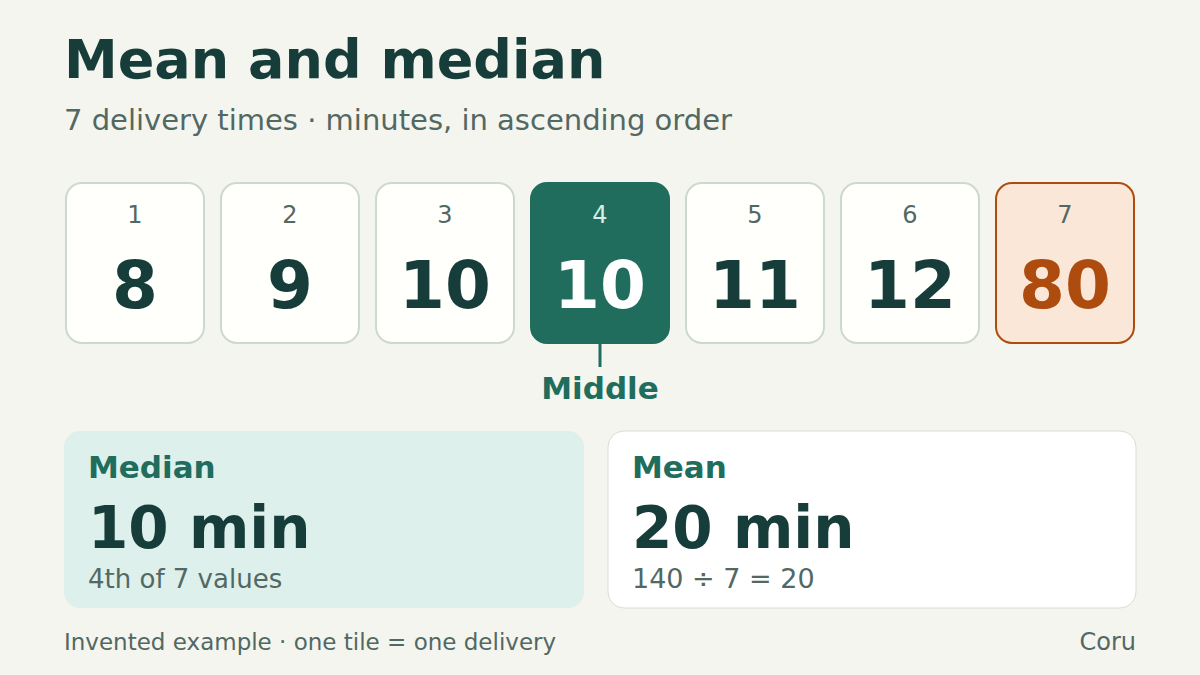
Seven deliveries, two correct answers
Imagine seven completed deliveries with these elapsed times in minutes: 8, 9, 10, 10, 11, 12, 80. These are invented teaching data, not measurements of a delivery service. The list is already sorted.
The arithmetic mean is 20 minutes; the median is 10 minutes. Neither calculation is wrong. Six deliveries took 8–12 minutes, while one took 80. A report that says only “average delivery: 20 minutes” hides that useful pattern.
Calculate the mean: share out the total
Add every duration: 8 + 9 + 10 + 10 + 11 + 12 + 80 = 140. Divide by the seven deliveries: 140 ÷ 7 = 20 minutes.
Think of redistributing the 140 recorded minutes equally across seven rows. Each row would receive 20. No actual delivery has to take exactly that long. Multiplying the mean by the number of observations recovers their total: 20 × 7 = 140.
This is a total of recorded durations, not necessarily 140 minutes on a clock: deliveries may overlap. Nor is elapsed delivery time automatically staff working time. For a staffing calculation, first measure the work time you actually need to add.
Calculate the median: find the middle position
Keep all seven values and sort them. The fourth value is 10, so the median is 10 minutes. The repeated 10 counts twice because it represents two deliveries.
With an even number of observations, take the mean of the two middle values. For the separate six-delivery list 8, 9, 10, 11, 12, 80, those are 10 and 11: the median is (10 + 11) ÷ 2 = 10.5 minutes. Its mean is 130 ÷ 6, approximately 21.67 minutes.
“Middle” refers to position in the sorted list, not halfway between the smallest and largest value. Here, (8 + 80) ÷ 2 = 44 is neither the mean nor the median.
Choose the number for the question
- What sits in the middle of this batch? Report the median, 10 minutes. It describes the middle position without letting the size of the 80-minute observation set that position.
- What is the recorded duration per delivery when every minute contributes? Report the mean, 20 minutes, alongside n = 7. The total is then recoverable.
- How should the batch be described to a reader? Give both: “Seven deliveries; median 10 minutes, mean 20 minutes; six took 8–12 minutes and one took 80.” That makes the long wait visible.
Investigate the 80; do not erase it
Check the original record, units and start/end definition. An extra zero or a different measurement rule needs investigation. If 80 is a real delivery measured by the same rule, its size alone is no reason to delete it. Correct verified mistakes and explain any exclusions.
As a separate what-if exercise, replace 80 with 17. The total becomes 77, the mean becomes 11 and the median stays 10. The last value moved, but the fourth position did not. A stable median can therefore coexist with a major change in the longest wait.
These seven invented observations cannot promise a future delivery time. Neither average describes every customer’s experience or shows how often a deadline will be missed.
Reproduce it in Excel
Enter the seven original numbers as numeric cells in A1:A7, one per row, with no heading inside that range. Put these formulas in other cells. AVERAGE returns 20; MEDIAN returns 10.
English Excel function names
excel
=AVERAGE(A1:A7)
=MEDIAN(A1:A7)
Each line is a separate formula. With Russian function names, use =СРЗНАЧ(A1:A7) and =МЕДИАНА(A1:A7).
Check what actually entered the calculation
For these range formulas, Excel ignores empty cells and text, including numbers stored as text; zero values count. A missing duration is not a measured zero. Check the input types and the count of numeric observations before interpreting either result. Do not replace unknown durations with zero just to fill the sheet.
Try a different long delivery
Calculate the sum and the middle position separately. Choose an answer, or open the explanations below.
Answers and explanations
- Mean 30; median 10: Yes. The total is 210 minutes: 210 ÷ 7 = 30. The fourth value is still 10.
- Mean 20; median 10: The median is still 10, but the total increased to 210, so the mean is now 30.
- Mean 30; median 30: The mean is 30, but the fourth sorted value is 10. Changing the largest value did not move that position.