Average speed: why equal distances need more than a simple mean
Add the distances and divide by the time. A 6 km leg at 12 km/h followed by 6 km at 6 km/h averages 8 km/h, not 9. Equal travel times give a different result.
Start with distance and time
Average speed is the total distance travelled divided by the time taken. For a whole outing, include stops in that time. To describe only movement, exclude stops and label the result “moving average speed”. These are different measurements.
The examples below are invented journeys, with constant speed on each moving leg. They are calculations, not recorded trips. Speeds and distances are positive; every time interval belongs to one journey.
Equal distances: why the answer is 8, not 9
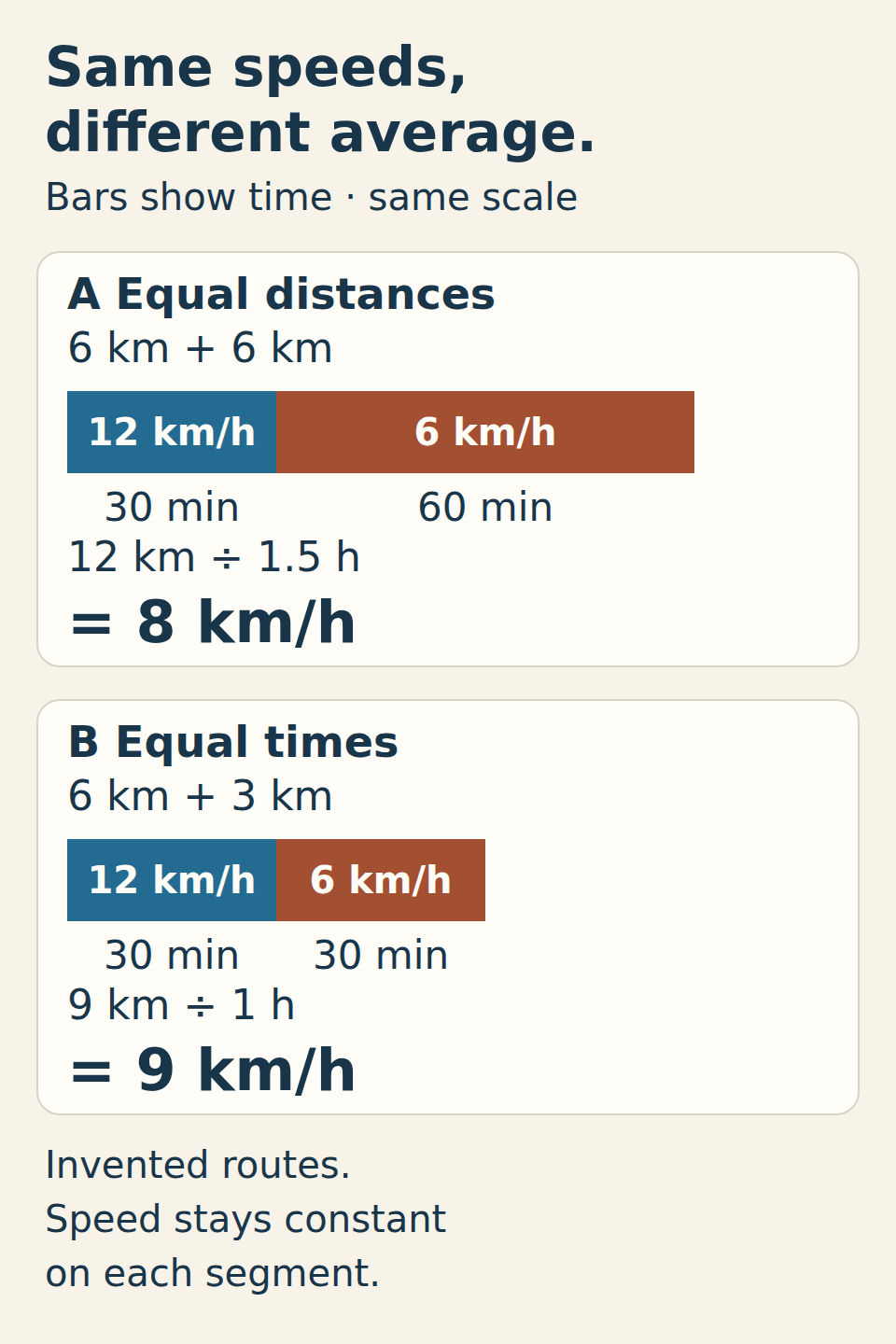
Imagine travelling 6 km at 12 km/h, then another 6 km at 6 km/h, without a stop. The total distance is 12 km. Work out the time of each leg before combining them:
- First leg: 6 ÷ 12 = 0.5 hour, or 30 minutes.
- Second leg: 6 ÷ 6 = 1 hour, or 60 minutes.
- Whole journey: 12 km ÷ 1.5 hours = 8 km/h.
Why the slower leg has more influence
The calculation (12 + 6) ÷ 2 = 9 gives both speed values equal weight. But you spend twice as long travelling at 6 km/h. A time-weighted average gives the correct result: (12 × 0.5 + 6 × 1) ÷ (0.5 + 1) = 8 km/h.
A useful check is to rebuild the distance. At an average of 8 km/h for 1.5 hours, you cover 12 km. Using 9 would imply 13.5 km, which is not this journey.
Equal times: when the ordinary mean works
Change the journey: travel for 30 minutes at 12 km/h and then 30 minutes at 6 km/h. Now the first distance is 6 km and the second is 3 km. Total distance 9 km, total time 1 hour: average speed 9 km/h.
For two moving legs of equal duration, the simple mean (v₁ + v₂) ÷ 2 works. Equal distances are a different condition. When both speeds are the same, both calculations coincide.
A stop changes the whole-trip average
Return to the original 6 km + 6 km journey and add a 30-minute stop. The distance stays 12 km; elapsed time becomes 30 + 60 + 30 = 120 minutes, or 2 hours. The whole-trip average is now 6 km/h. The moving average remains 8 km/h.
A stop adds time and no distance. Include it as a separate interval; do not try to calculate its duration by dividing zero distance by zero speed. If an app reports a different average, check whether it uses moving time or elapsed time. Pause detection can also differ between apps.
Use a small trip log
For each leg, write down distance and duration. If a leg’s distance and average speed are known, calculate duration = distance ÷ speed. Add the distances, add the durations, then divide the two totals. If a leg’s duration already includes a stop, do not add that stop a second time.
With distances in kilometres and times in minutes, use: average speed in km/h = 60 × total kilometres ÷ total minutes. For the original journey: 60 × 12 ÷ 90 = 8.
Convert units before calculating. One hour thirty minutes is 1.5 hours, not 1.30 hours; 1.30 hours is 78 minutes. Keep full values during the calculation and round the final answer.
A shortcut for two equal distances
If two legs have equal positive distances, positive speeds v₁ and v₂, and no additional stopping time, the result is 2 × v₁ × v₂ ÷ (v₁ + v₂). This is the harmonic mean of the two speeds. For 12 and 6: 2 × 12 × 6 ÷ 18 = 8 km/h.
For unequal distances, return to total distance divided by total time. On a journey back to your starting point, the distance still includes both legs. In physics, average velocity uses displacement instead; it is zero on a round trip even though average speed is positive.
Try another journey
Choose an answer, or open the explanations below. Find the time of each leg first.
Answers and explanations
- 8 km/h: That is the simple mean of the two speeds. The legs take 60 and 20 minutes, so their time weights are unequal.
- 6 km/h: Correct: 4 ÷ 4 = 1 hour, and 4 ÷ 12 = 1/3 hour. Total distance 8 km; total time 80 minutes. So 60 × 8 ÷ 80 = 6 km/h.
- 12 km/h: That is only the second leg’s speed. The first 4 km takes a full hour, so the whole journey cannot average 12 km/h.