At least one success: why six rolls do not guarantee a six
The probability of at least one six in six independent rolls of a fair die is about 66.51%. Find it by subtracting the chance of no sixes from 100%. Multiplying 6 × 1/6 gives an expected count, not a guarantee.
Six chances are not a promise
For a fair six-sided die, a six has probability 1/6 on each roll. Assume the rolls are independent: previous outcomes do not change the probabilities on the next roll. We choose the number of rolls in advance.
The tempting calculation 6 × 1/6 = 1 answers a different question: the expected number of sixes in six rolls is one. A batch can contain zero, one or several sixes. An average count of one does not mean every batch contains one.
Start with two rolls: where the extra count comes from
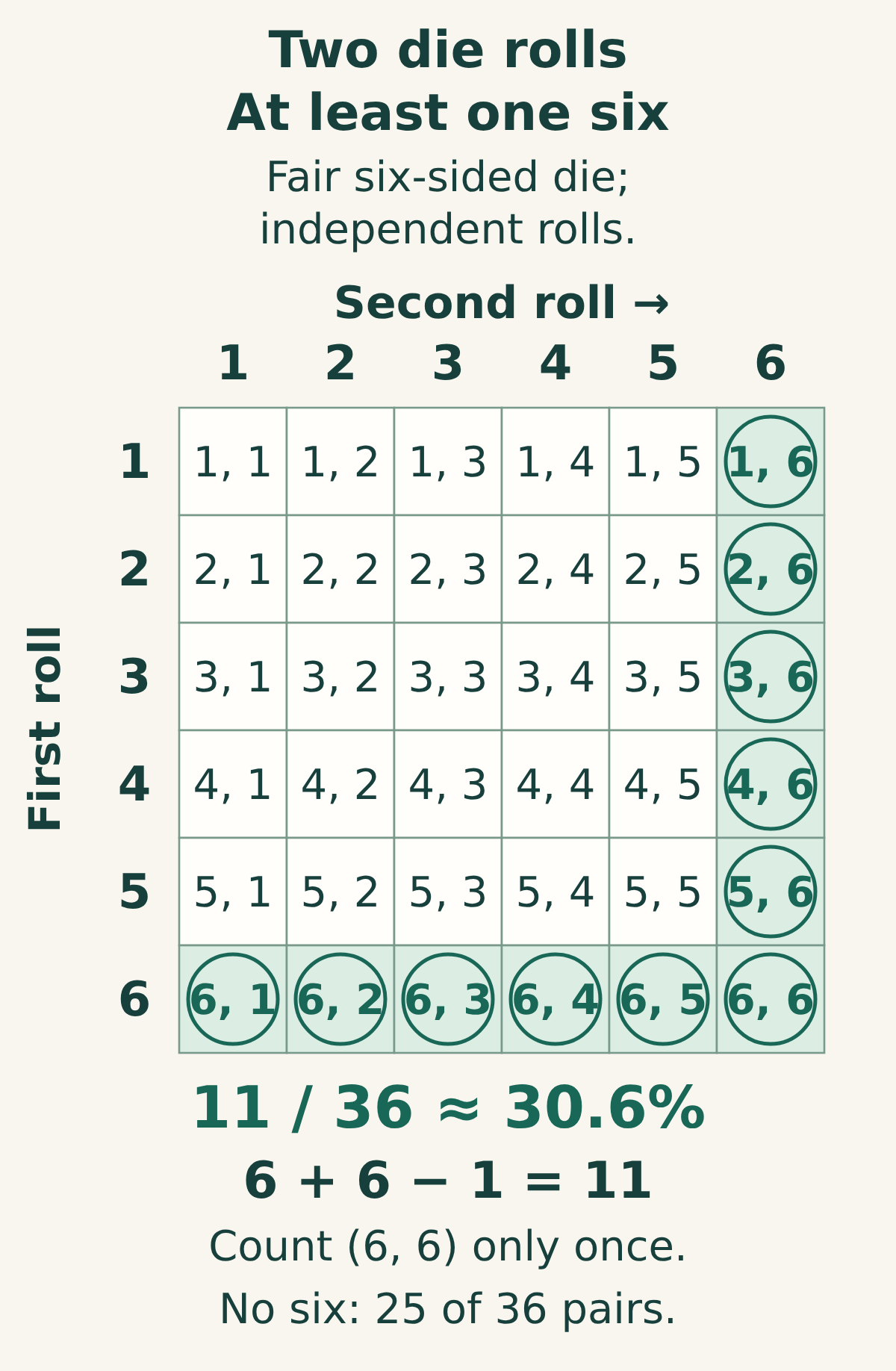
Label the results first roll and second roll. There are 6 × 6 = 36 equally likely ordered pairs. Six pairs have a six on the first roll; six have a six on the second.
The pair (6, 6) belongs to both groups. Adding 6 + 6 counts it twice, although it is only one successful pair. Count it once: 6 + 6 − 1 = 11. The probability of at least one six in two rolls is 11/36, about 30.6%, not 1/3.
There is a shorter count: both rolls avoid a six in 5 × 5 = 25 pairs. The other 36 − 25 = 11 contain at least one six. This second approach scales to longer sequences.
For six rolls, count the chance of none
A single roll avoids a six with probability 5/6. Independence lets us multiply those probabilities. All six rolls avoid a six with probability (5/6)⁶ = 15625/46656, about 33.49%.
“No sixes” and “at least one six” are the two complementary possibilities. Their probabilities add to one. So the chance of at least one six is 1 − (5/6)⁶ = 31031/46656, about 66.51%.
That still leaves roughly one chance in three of no six at all. This is a model calculation, not a guarantee about any particular batch.
One formula for a fixed number of independent attempts
P(at least one success) = 1 − (1 − p)^n

p = success probability on each attempt
n = number of attempts, chosen in advance
Use 0 ≤ p ≤ 1 and a nonnegative whole number n. For n = 0, the chance is 0: no attempts means no success. For n ≥ 1, use the formula directly.
More attempts help, but do not force success
For a fair die and independent rolls, the probability of at least one six is:
- 1 roll: about 16.67%.
- 2 rolls: about 30.56%.
- 6 rolls: about 66.51%.
- 10 rolls: about 83.85%.
- 17 rolls: about 95.49%.
95% is not certainty
Seventeen rolls is the smallest fixed number that reaches at least a 95% chance in this model; sixteen gives about 94.59%. Even seventeen can produce no six. For 0 < p < 1, every finite number of independent attempts leaves a positive probability of no success.
If five rolls have already produced no six, the chance on the next roll remains 1/6. The 66.51% result described the entire six-roll sequence before it began; it is not the probability left after seeing five failures.
Try the calculation in a spreadsheet
=1-(1-1/6)^6This formula uses only arithmetic and returns about 0.665102. Format the cell as a percentage to see about 66.51%. Replace the final 6 with a different fixed number of rolls.
A small activity: count batches, not sixes
Before starting, decide to record 20 batches of six rolls with a fair die, shaking it before each roll. Finish all six rolls in every batch. For each batch, write 1 if any six appeared and 0 otherwise.
Add the 1s and divide by 20. This estimates the proportion of batches with at least one six. A batch with three sixes still contributes only one 1. The observed result may be far from 66.51% in such a small trial.
Separately, add all the sixes and divide by 20 to find the average number per batch; compare that average with the expected count of one. Keep these two measurements separate. We have checked the mathematical counts, but have not performed this physical activity.
Check the assumptions before reusing the formula
The compact formula assumes independent attempts with the same success probability. If independent attempts have different known probabilities p₁, p₂, …, use 1 − (1 − p₁)(1 − p₂)… instead.
Drawing cards without replacement changes the remaining deck; consecutive weather outcomes can be related. Do not apply the fixed-p independent formula just because a question mentions several chances. First identify the success, the number of attempts and whether the model fits.
Try the same reasoning with a coin
Choose an answer and read the feedback. The Answers section also contains every explanation without JavaScript.
Answers and explanations
- 50%: 50% is the chance on one toss. Three tosses give more opportunities; count the chance of no heads first.
- 87.5%: Correct. Only TTT has no head: (1/2)³ = 1/8. The other seven of eight equally likely sequences contain a head.
- 150%: 3 × 50% = 1.5 is the expected number of heads, not a probability. A probability cannot exceed 100%.