Probability without replacement: why the second draw changes
With three blue tokens and two orange tokens, the chance of drawing two blues without putting the first back is 3/5 × 2/4 = 30%. The second fraction describes what remains after a blue first draw.
Start with five distinct tokens
Label three blue tokens A, B and C, and two orange tokens D and E. Draw one, leave it out, then draw a second. Assume each token still in the bag is equally likely to be selected. The labels let us count individual outcomes, even though the question is about colors.
“Without replacement” means the first token stays out until both draws are finished. The draws are dependent: knowing the first color changes the chance of the second color.
Two blues: update both the numerator and denominator
The first draw has three blue tokens among five, so its chance of being blue is 3/5. If it is blue, two blue tokens remain among four. The chance of blue on that second draw is now 2/4.
Multiply along this route: P(two blues) = 3/5 × 2/4 = 6/20 = 3/10 = 30%. The 2/4 is a conditional probability: it applies given that the first token was blue.
If you put the first token back and mix before drawing again, all five are available again. Under the same uniform-selection model, the chance of two blues is then 3/5 × 3/5 = 9/25 = 36%. That calculation answers a different experiment.
Count the 20 pairs to check the calculation
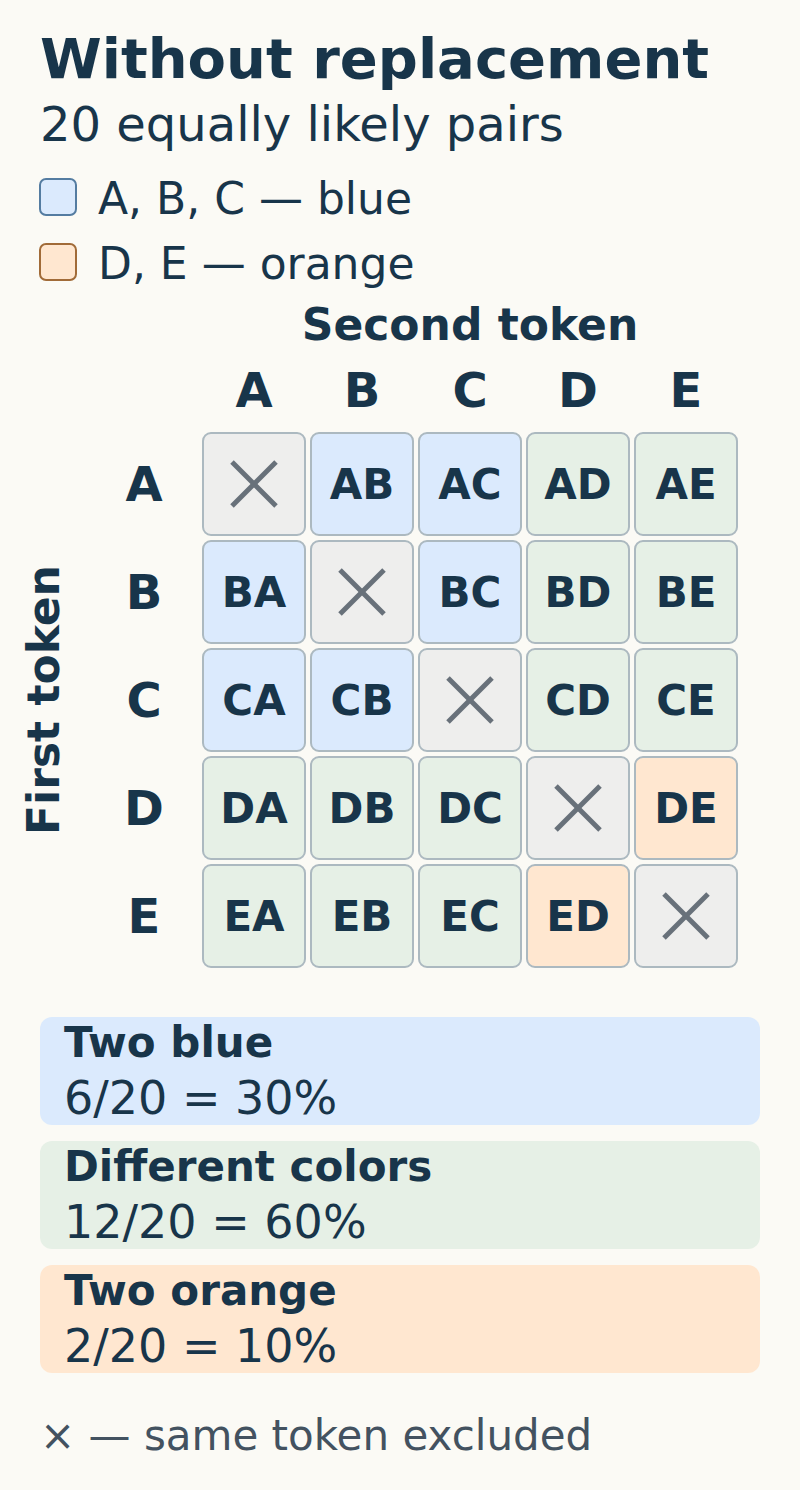
There are five choices for the first token and four remaining choices for the second: 5 × 4 = 20 ordered pairs. Each has probability 1/5 × 1/4 = 1/20. A→B and B→A are different sequences, and both count.
The diagonal cells A→A, B→B, C→C, D→D and E→E are impossible without replacement. Of the other cells, six contain two blue tokens: A→B, A→C, B→A, B→C, C→A and C→B. Six of twenty agrees with 30%.
One of each color: include both orders
Blue then orange has probability 3/5 × 2/4 = 6/20. Orange then blue has probability 2/5 × 3/4 = 6/20. These routes cannot both happen in the same pair of draws, so add them: P(one of each) = 12/20 = 60%.
The probability of two orange tokens is 2/5 × 1/4 = 2/20 = 10%. The three categories cover every pair: 30% + 60% + 10% = 100%.
The four color sequences are not equally likely. Blue–blue, blue–orange and orange–blue each account for six labeled pairs; orange–orange accounts for only two. Counting four color sequences and assigning each 25% loses that difference.
Four routes, with the bag updated after the first draw
text
blue → blue:     (3/5) × (2/4) = 6/20
blue → orange:   (3/5) × (2/4) = 6/20
orange → blue:   (2/5) × (3/4) = 6/20
orange → orange: (2/5) × (1/4) = 2/20
Multiply within one route. Add mutually exclusive routes when they answer the same question.
Why the second draw is still 60% blue before you see the first
Before either draw, the overall chance that the second token will be blue is still 3/5. In the grid, each of the three blue columns contains four allowed cells: 12/20 = 60%. This does not make the draws independent.
Once you know the first token was blue, the second-blue chance is 2/4 = 50%. If the first was orange, it is 3/4 = 75%. Combining the two possible histories before seeing either gives (3/5 × 2/4) + (2/5 × 3/4) = 12/20.
Ask what information the question gives you. “The second is blue” and “the second is blue, given that the first was blue” use different information. A matching overall percentage is not evidence of independence.
Try a small paper-token activity
Use five equal-size slips, marked A, B, C, D and E on the inside and folded alike. Treat A/B/C as blue and D/E as orange; actual colored paper is optional. Mix them in an opaque container and select without looking. This approximates the uniform-selection model; it does not certify that every physical draw is equally likely.
- Prepare 20 numbered rows on paper. Draw two slips without replacement, record their labels in order, and mark the category: two blue, mixed, or two orange.
- Return both slips and mix before starting the next row. Otherwise, later rows would use a different bag.
- Check that the three category counts add to 20. Divide each count by 20 to get its observed proportion, and compare with 30%, 60% and 10%.
- A set of 20 trials need not contain exactly six two-blue pairs, twelve mixed pairs and two two-orange pairs. Those are expected counts, not a guaranteed schedule. The calculations and outcome counts here are checked; this physical activity has not been performed by Coru.
A rule you can reuse
For N tokens containing B blue tokens, two uniform draws without replacement have P(two blues) = (B/N) × ((B − 1)/(N − 1)), provided N ≥ 2 and 1 ≤ B ≤ N. If B = 0, the probability is zero. Counts are whole numbers.
More generally, P(A and B) = P(A) × P(B given A), when P(A) is positive. Independence is the special case where learning A does not change B’s probability. Without replacement, update the contents for each route instead of reusing the first fraction.
Check the information you have
Choose an answer, then read the explanation. All choices and explanations are also available in “Answers” below.
Answers and explanations
- 3/5 = 60%: That is the blue fraction in the original bag. One orange token has now been removed, so only four tokens remain.
- 3/4 = 75%: All three blue tokens remain, among four tokens in total.
- 2/4 = 50%: Two blues would remain after a blue first draw. This question says the first was orange, so three blues remain.