Two discounts of 20% and 10%: why the total is 28%
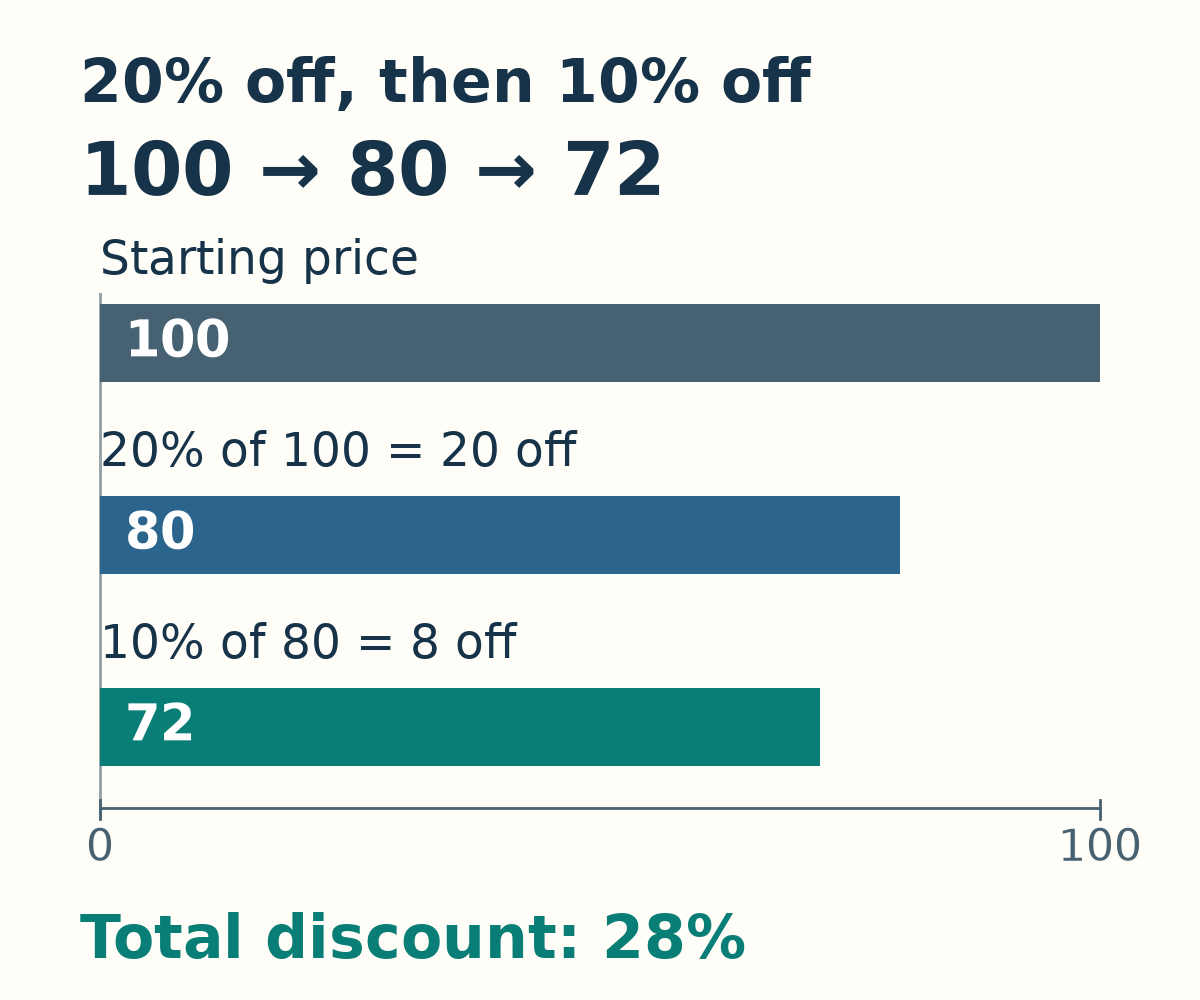
A 20% discount leaves 80% of the original price. A further 10% off that reduced price leaves 90% of 80%: 72%. You save 28%, not 30%. The second percentage has a smaller base.
Follow the current price
Imagine a sketchbook priced at 250 units. A first discount takes 20% off. A second offer takes another 10% off the reduced price. These are invented numbers; no fixed charge or intermediate rounding is included.
- First saving: 250 × 20% = 50. Current price: 250 − 50 = 200.
- Second saving: 200 × 10% = 20. Final price: 200 − 20 = 180.
- Total saving: 250 − 180 = 70. Relative to the original price: 70 ÷ 250 = 28%.
Multiply what remains
Write a discount as a multiplier: 20% off means multiply by 1 − 0.20 = 0.80; 10% off means multiply by 0.90. Each multiplier acts on the value immediately before it.
Final price = original price × 0.80 × 0.90. The combined multiplier is 0.72, so the equivalent single discount is 1 − 0.72 = 0.28, or 28%.
Adding 20% + 10% = 30% would treat both reductions as percentages of the original. That is a different offer: 50 + 25 off our 250-unit sketchbook would leave 175. Check which base the offer actually names.
A reusable two-discount calculation
text
a = first discount as a fraction
b = second discount as a fraction
Final = Original × (1 − a) × (1 − b)
Combined discount = 1 − (1 − a) × (1 − b)
For 20% and 10%, enter a = 0.20 and b = 0.10. The combined discount is a fraction; 0.28 means 28%. These discounts are between 0% and 100%, applied successively.
Does the order matter?
For these exact percentage-only changes, no: 250 × 0.80 × 0.90 = 250 × 0.90 × 0.80 = 180. The separate savings differ: 50 then 20 in one order; 25 then 45 in the other. Both total 70.
That statement assumes the same percentage multipliers apply to the entire current amount, with no rounding between steps. Eligibility rules, caps, fixed deductions or fees can change the calculation.
For example, take a price of 100 and a fixed fee of 10. Discounting only the price by 20%, then adding the fee gives 100 × 0.80 + 10 = 90. Adding the fee first and discounting the whole 110 gives (100 + 10) × 0.80 = 88. These differ because the second rule discounts the fee too. Follow the stated rule rather than rearranging it.
A rise and fall of 20% do not cancel
Start at 100. Increasing it by 20% gives 120. Decreasing that result by 20% removes 24, leaving 96: a net decrease of 4%. In multipliers, 1.20 × 0.80 = 0.96.
To calculate any net percentage change from a positive starting amount, use (final ÷ original − 1) × 100%. A positive result means an increase; a negative result means a decrease. A zero starting amount has no defined relative percentage change.
Returning from 80 to 100 instead requires a 25% increase: the missing 20 is 25% of 80. The related reverse-percentage guide explains how to recover an original amount.
Try it: 25% off, then another 20%
Start at 200 and apply the second discount to the reduced amount. Choose an answer, or open the explanations below.
Answers and explanations
- 45%: That adds the two rates as if both used the original base. The second discount is 20% of 150, not 20% of 200.
- 40%: Yes. 200 × 0.75 = 150; 150 × 0.80 = 120. The saving is 80 out of 200: 40%.
- 60%: 60% is the fraction of the original price still paid: 120 ÷ 200. The discount is the remaining 40%.
Check your own calculation
- Name the amount each percentage applies to: original price, reduced price, or a specified subtotal.
- Write one row per step: starting amount, rate, amount removed or added, new amount.
- Apply any fixed charges and rounding at the stage the rules specify. The examples here keep intermediate values exact.
- Compare the final amount with the original. Keep “percentage still paid” separate from “percentage saved”.